Showing posts with label spanish conquest. Show all posts

Moctezuma Meets Cortes - Nov 8, 1519

On November 8, 1519, Aztec Emperor Moctezuma and Spanish Conquistador Hernan Cortes met for the first time outside the Aztec capital city of Tenochtitlan.

Aztec accounts of the event, compiled by Miguel Leon-Portillo shortly after and published as The Broken Spears, claim that Moctezuma (also Montezuma) believed Cortes was a god.

“Our Lord, you are weary. The journey has tired you, but now you have arrived on the earth. You have come here to site on your throne, to sit under its canopy.”

The accounts also say that Cortes told Moctezuma, “We have come to your house in Mexico as friends. There is nothing to fear.”

Moctezuma would soon be dead, and Cortes would be the ruler of New Spain.

A critical moment in history? I would say so.

Cabeza de Vaca Runs Aground in Texas - Nov 6, 1528

Near land a great wave took us and cast the boat out of the water as far as a horseshoe can be tossed. The boat ran aground with such force that it revived the men on it who were almost dead. When they saw they were near land they pushed themselves overboard and crawled on their hands and knees. When they got to the beach, we lit a fire by some rocks and toasted some of the corn we had and found rain water. With the warmth of the fire, the men revived and began to regain some of their strength. We arrived at this place on the sixth of November.


Such was the account of Alvar Nuñez Cabeza de Vaca of the shipwreck of November 6, 1528, possibly near modern day Galveston Island, Texas. Shipwreck is a bit generous, actually. The real "ships", aboard which the expedition left Cuba in March, were long since lost because expedition commander Pánfilo de Narváez foolishly decided to seperate his forces into a land and a sea party when they landed near modern Tampa Bay.

Pizarro and the Spanish Conquest of the Inca Empire

Francisco Pizarro

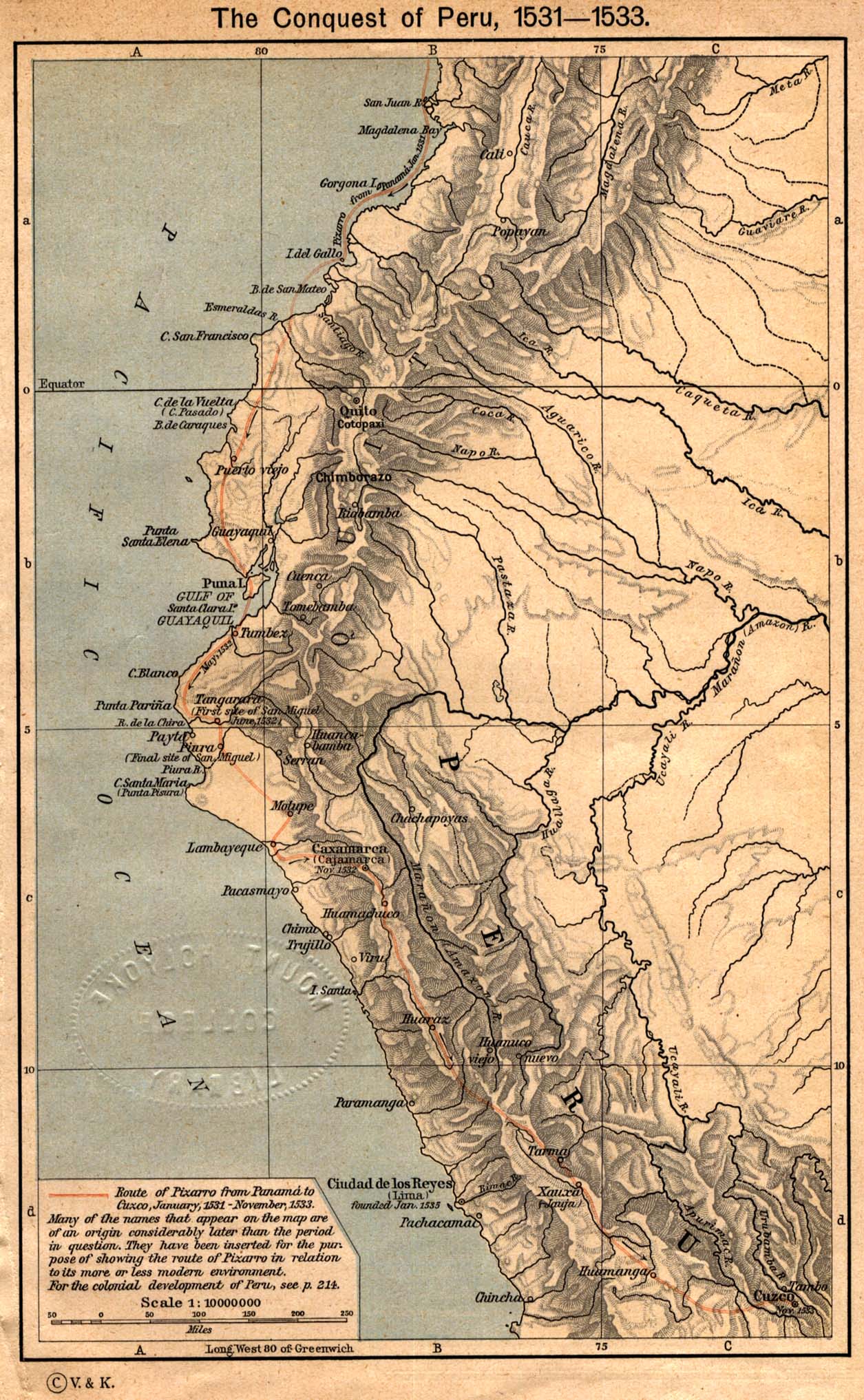
Francisco Pizarro was a conquistador in the truest sense of the word. He conquered the Incas, the largest empire in the Western Hemisphere, with only a few hundred men and established a Spanish foothold in South America that would last for several centuries to come.

The son of a Spanish soldier, Pizarro, like Hernan Cortes, was not of royal descent. He was, however, driven by the desire for fame, fortune, and adventure. Like many Spaniards of his day, he sought to make these dreams come true in the New World.

Pizarro was with Nunez de Balboa during his 1513 expedition in Panama. Balboa’s expedition is believed to be the first time any European saw the Pacific Ocean. While in Panama, Pizarro heard many rumors about a rich empire to the south. These rumors were true of course. The Inca Empire had wealth even greater than that of the Aztec Empire of Mexico.

For the next 15 years, Pizarro moved slowly south and helped to subdue native tribes. At every step, he continued hearing about the rich empire of the Incas. In fact, Pizarro did find the Incan city of Tumbes (sometimes spelled Tumbez). This, along with visits to two other Incan cities in the region, convinced Pizarro that he needed to explore further south and that he needed more men.

In 1528, Pizarro sailed to Spain to get support from King Charles V of Spain for a full-scale expedition to find and conquer the huge empire he had heard about. He took several natives, a llama, and New World golden treasures and showed them to the Spanish monarch. Charles V agreed to finance the expedition, and named Pizarro Governor and Captain General of the territories he would soon conquer.

Conquest of the Incas

Pizarro knew the conquest of the Incas would not be easy. He had the benefit, however, of knowing the strategies and tactics that Cortes used against the Aztecs, and Pizarro used many of them quite successfully against the Incas. Cortes went against the Aztecs less than 30 years after the arrival of Columbus, when Spain still barely had a foothold in the New World. Pizarro had a much larger body of knowledge to draw on when he set out from Panama in 1530 to conquer the Incas.

Pizarro also had the benefit of having other seasoned conquistadors along with him. Among these were Pizarro’s brothers, and in 1532, Hernando de Soto (the conquistador who explored Florida a few years later) joined the expedition.

From 1530 to 1532, Pizarro and his expedition probed the outskirts of the Inca Empire, conquering and recruiting allies along the way. He also discovered that the Incas were already fighting a war. This of course was a huge advantage to Pizarro. It slowed communication among the Incas, and it meant easier recruitment of allies that were hostile toward the central government of the Incas.

Perhaps the defining moment in Pizarro’s conquest of the Incas was the capture of Emperor Atahualpa. Like Cortés’s capture of Moctezuma II, Pizarro’s capture of Atahualpa increased the confusion among the Incas, and helped slow the response to the inevitable attack on the heart of the Incan Empire.

Pizarro and Atahualpa met in 1532 at the city of Cajamarca. Pizarro had only about 180 men, but he also had the advantage of firearms, cannon, and horses. Atahualpa had thousands of Incan warriors with him.

Pizarro’s secretary, Francisco de Xeres wrote about the approach of Atahualpa.


First came a squadron of Indians dressed in a livery of different colors, like a chessboard. They advanced, removing the straws from the ground and sweeping the road. Next came three squadrons in different dresses, dancing and singing. Then came a number of men with armor, large metal plates, and crowns of gold and silver. Among them was Atahualpa in a litter lined with plumes of macaws' feathers of many colors and adorned with plates of gold and silver. Many Indians carried it on their shoulders on high . . .


According to Xeres, Pizarro sent a priest to speak first to the Incan emperor. The priest, Vicente, approached Atahualpa with a bible and said


I am a priest of God, and I teach Christians the things of God, and in like manner I come to teach you. What I teach is that which God says to us in this Book. Therefore, on the part of God and of the Christians, I beseech you to be their friend, for such is God's will, and it will be for your good. Go and speak to the Governor, who waits for you.


In effect, Friar Vicente was telling Atahualpa that resistance was futile. The Spaniards believed that, despite the long odds, they would be victorious (by peaceful means or otherwise) because God was on their side.

Xeres further reported that Atahualpa asked to see the Bible he was carrying, opened it, and threw it saying, “I know well how you have behaved on the road, how you have treated my chiefs, and taken the cloth from my storehouses… I will not leave this place until they bring it all to me.”

Vicente then returned to Pizarro and told him what happened. Chaos ensued…


Atahualpa stood up on the top of the litter, addressing his troops and ordering them to be prepared. The monk told the Governor what had passed between him and Atahualpa, and that he had thrown the Scriptures to the ground. Then the Governor put on a jacket of cotton, took his sword and dagger, and, with the Spaniards who were with him, entered amongst the Indians most valiantly; and, with only four men who were able to follow him, he came to the litter where Atahualpa was, and fearlessly seized him by the arm, crying out, "Santiago!" Then the guns were fired off, the trumpets were sounded, and the troops, both horse and foot, sallied forth. On seeing the horses charge, many of the Indians who were in the open space fled, and such was the force with which they ran that they broke down part of the wall surrounding it, and many fell over each other. The horsemen rode them down, killing and wounding, and following in pursuit. The infantry made so good an assault upon those that remained that in a short time most of them were put to the sword. The Governor still held Atahualpa by the arm, not being able to pull him out of the litter because he was raised so high. Then the Spaniards made such a slaughter amongst those who carried the litter that they fell to the ground, and, if the Governor had not protected Atahualpa, that proud man would there have paid for all the cruelties he had committed. The Governor, in protecting Atahualpa, received a slight wound in the hand. During the whole time no Indian raised his arms against a Spaniard.


And so it was that the great Atahualpa was captured. The Incan emperor assumed that he would be killed by the invaders if they did not get what they wanted—gold. He was partly right. Gold was a primary motivation for the Spaniards in the New World, but they also wanted the true measure of wealth in their culture—land.

It merits reference that the Incas and Atahualpa probably did not understand the concept of land ownership. In most Native American cultures, such a concept did not exist. Native Americans had the belief that they belonged to the land, not the other way around.

Because he believed all the Spanish wanted was gold, Atahualpa made a generous offer to Pizarro, in the hope that the Spaniards would leave.


Atahualpa said: "I will give gold enough to fill a room twenty-two feet long and seventeen wide, up to a white line which is halfway up the wall." The height would be that of a man's stature and a half. He said that, up to that mark, he would fill the room with different kinds of golden vessels, such as jars, pots, vases, besides lumps and other pieces. As for silver, he said he would fill the whole chamber with it twice over. He undertook to do this in two months. The Governor told him to send off messengers with this object, and that, when it was accomplished, he need have no fear....


Realistically of course, Pizarro had no intention of letting Atahualpa go, but he could not refuse such a handsome offer. Pizarro must have also known that the Incas would not stand idly by and let their emperor be held in captivity. Perhaps, Pizarro used Atahualpa as bait to draw some of the empires remaining high officials into a fight. Whether or not this was the plan, word got back to Pizarro that the Incas were planning a counterattack, and the Spaniard seized the opportunity to charge Atahualpa with treason and execute him.


Then the Governor, with the concurrence of the officers of his Majesty, and of the captains and persons of experience, sentenced Atahualpa to death. His sentence was that, for the treason he had committed, he should die by burning, unless he became a Christian . . .

They brought out Atahualpa to execution; and, when he came into the square, he said he would become a Christian. The Governor was informed, and ordered him to be baptized. The ceremony was performed by the very reverend Father Friar Vicente de Valverde. The Governor then ordered that he should not be burned, but that he should be fastened to a pole in the open space and strangled. This was done, and the body was left until the morning of the next day, when the monks, and the Governor with the other Spaniards, conveyed it into the church, where it was interred with much solemnity, and with all the honors that could be shown it. Such was the end of this man, who had been so cruel. He died with great fortitude, and without showing any feeling . . .


One cannot help but question whether Xeres’s account is reliable. The section quoted above, however, does align with the practices of the day. Read any book about the inquisitions of the Church in Europe, and you will find very similar happenings. Non-Christians or Christians believed to be heretics were rounded up and asked to repent. Depending on the alleged crime, if the accused did repent, they could be executed anyway. The penalty for those that did not repent was most certainly always execution by burning. The fact is that Pizarro probably would have been well within his rights, by the standards of the day, to have executed Atahualpa immediately after he threw the Bible at their first meeting.

No doubt, the capture and execution/murder of Atahualpa hurt the Incas, but it did not lessen their resolve. They fought on, but their fate was sealed. Like the Aztecs and countless other Native American tribes, disease, inferior technology, and the world view of their opponents meant annihilation. Some estimates claim that 90% of the Incas were killed by disease alone. They continued their fight against the Spanish with spears and slings, but these weapons were no match for swords, crossbows and cannons. Furthermore, the Spanish believed it was their right and duty to conquer, subdue, and Christianize the Incas and anyone else they came upon.

In 1533, the Incan capital of Cuzco fell to the Spaniards. The conquest then continued south until Spain controlled all of Mexico, Central America, and South America (except Brazil and a few other small regions).

Francisco Pizarro went on to found the city of Lima, Peru in 1535. He ruled the South American portion of Spain’s New World empire from Lima until his assassination in 1541 at the hands of a rival conquistador’s men.

Related Links:

CATHOLIC ENCYCLOPEDIA: Francisco Pizarro
Capture of an Inca King: Francisco Pizarro
Incas and Conquistadors

Hernan Cortes and the Spanish Conquest of Mexico

Early Spanish Expeditions to Mexico

Governor Velasquez of Cuba sponsored three voyages from Cuba to Mexico to search for the rich empire the Spanish believed was there.

The first voyage was led by Francisco Hernandez de Cordoba. Cordoba left Cuba in 1517 with a party of 110 men. Among his men was Bernal Diaz. Diaz later wrote a complete account of the Conquest of Mexico.

Cordoba’s party landed on the Yucatan Peninsula. Incidentally, the name Yucatan comes from the native expression “I do not understand you.” This is what the natives said when the Spanish asked the name of that place, and as a result, it became known as Yucatan.

A battle ensued between the Spaniards and Maya warriors on the Yucatan, and Cordoba died as a result of wounds inflicted in the fight.

The second of Velasquez’s expeditions to Mexico departed Cuba in 1518 with a party of 240 men under the command of Juan de Grijalva, Velasquez’s nephew. Among the men were some Maya warriors captured during the first expedition. These Mayans served as translators for the expedition.

The group fought their way inland and eventually made it to the edge of the Aztec Empire, near modern day Veracruz. There they met with some Aztecs with whom they traded and had a feast. During this expedition, the Spanish began to see evidence of human sacrifice at some of the Aztec temples they say.

The next attempt to conquer Mexico was led by Hernan Cortes.

Hernan Cortes
Cortes was a hidalgo, a non-royal blooded Spanish noble. In 1502, at the age of 17, Cortes decided to seek his fortune in the New World. In 1504, he arrived in Hispaniola. There he tried mining and became a notary. In 1511, Cortes went with Velasquez and helped in the conquest of Cuba. Cortes performed well under Velasquez and was awarded land and laborers.

In Cuba, Cortes panned for gold, started a sugar plantation, and had herds of livestock. Eventually, Cortes became somewhat wealthy and became mayor of Santiago, one of the biggest Spanish towns in Cuba. He also married Governor Velasquez’s sister-in law.

In 1518, Velasques sent Cortes orders to take an expedition to Mexico. Just before the voyage was to begin in 1519, however, some of Cortes’s rivals convinced Velasquez to remove Cortes as commander of the expedition. Velasquez sent the orders to Cortes, but in February of 1519, Cortes sailed for Mexico anyway.

Cortes in Mexico

Cortes’s party had a force of 508 men, 100 sailors, 2 priests, 10 cannons, 2 greyhounds, and 16 horses. The soldiers were armed with crossbows, muskets, and swords. Many of the men under Cortes’s men were veterans of the conquest of the Caribbean.

The party made landfall at the island of Cozumel. There, Cortes ransomed Spanish prisoners taken in skirmishes during the first expedition to Yucatan. Cortes and his men fought a battle against several thousand warriors. At this time, Cortes noted that the natives were terrified of horses and that a conquistador on horseback could take on many natives fighting on foot. At the end of the battle, Cortes officially claimed the land for the Spanish king.

The chiefs of those that opposed Cortes in this first battle came to make peace with the Spaniards. The chiefs brought gifts, including slaves and women. One of these women was a young woman named Malinche. She spoke Nahuatl, the Aztec language. Throughout Cortes’s campaign in Mexico, she translated Nahuatl into Maya, and then one of the Spanish prisoners Cortes ransomed at Cozumel translated Maya into Spanish. Malinche proved to be invaluable to Cortes in the conquest of Mexico. Malinche would eventually be renamed Marina, after being baptized by a Spanish priest.

On Friday, April 22, 1519, Cortes and his party set up a temporary headquarters near the future location of Veracruz. Some Aztecs met him there with gifts. For the next few months, Cortes stayed at his headquarters talking to Aztecs. He was trying to find out as much as he could about the Aztec Empire. The Aztecs he met had been sent by Emperor Moctezuma to find out about the Spanish as well. During this period, the Spanish priests performed ceremonies, and Cortes told the Aztecs that they were representatives of King Charles V who wanted to be a friend to the Aztecs.

The Spaniards also demonstrated their cannons and put on shows with their horses. The Aztecs had artists paint pictures of these events to show Moctezuma, and these pictures were sent by runner with other information to Tenochtitlan, the Aztec capital. The Spanish also sent gifts of beads, and armchair for Moctezuma, and other assorted gifts.

The Aztecs were not stingy with gifts. They gave Cortes loads of cotton cloth, colored feathers, gold ornaments, gold nuggets, and some religious items that were often jeweled and covered with gold.

During this intermission, Cortes founded the town of Veracruz. He also talked to members of other tribes in the area that had been conquered by the Aztecs. These natives told of their mistreatment by the Aztecs and the enormous taxes that they had to pay to the emperor. Catholic priests also set out destroying native temples and building Christian churches in their place. Some members of the rival tribes were baptized.

Cortes then began making preparations to march to Tenochtitlan. He learned about a plot among some of the Spaniards to desert Cortes and sail back to Cuba. Cortes hanged two of the plotters. He then ordered all his ships burned, thereby removing any chance to return to Cuba.


(click here for a larger map)


On August 16, 1519, Cortes and his forces left Veracruz and began the march to Tenochtitlan. Along the way, he recruited about 5,000 warriors from rival tribes, destroyed temples, and Christianized many natives.

The march to Tenochtitlan was difficult. The Spaniards had to negotiate jungles and mountain passes. Finally, in November of 1519, Cortes and his party neared Tenochtitlan.

Cortes, Moctezuma, and the Conquest of the Aztecs

Cortes finally met Moctezuma on November 8, 1519, just outside of Tenochtitlan. The Aztec emperor was carried on a litter by slaves. He got down from the litter, and the two men greeted each other. Cortes placed a gold necklace with colored glass beads on it around Moctezuma’s neck. Bernal Diaz, one of Cortes’s men, said that the two men “showed great respect toward one another.” Moctezuma then had some of his men show Cortes's party to where they would stay in Tenochtitlan.

Moctezuma was somehow convinced to move in with Cortes and his men at the old imperial palace. Moctezuma then became basically a puppet for Cortes. Cortes gave orders to Moctezuma, and then Moctezuma issued them to the Aztec people. For the next five months, Cortes’s men explored the Aztec empire and strategized about how to bring it under Spanish control.

Meanwhile, Moctezuma’s nephew and brother plotted how to get rid of the Spaniards. Cortes convinced Moctezuma to have them arrested. Cortes also had his men destroy Aztec temples and replaced them with Christian churches. The Aztecs were outraged and told the Spanish to leave their lands. Cortes and the Spanish refused.

In the spring of 1520, Cortes learned tha the Aztecs were about to have their spring festival, during which many human sacrificed were to be performed. The festival was to be followed by a general attack on the Spaniards and their native allies. Cortes’s army killed many Aztecs at the festival. The Aztecs then trapped Cortes, Moctezuma, and most of the Spanish army inside the old imperial palace.

Moctezuma died in the attack that followed. Some believe a stone thrown by Aztecs killed him. Others believe the Spanish stabbed him to death.

Cortes and his men planned an escape from Tenochtitlan, knowing that they were greatly outnumbered. The escape was to take place under cover of night on June 30, 1520. As the Spanish and their allies moved across one of the causeways that bridged Lake Texcoco, they were ambushed by Aztec warriors. During the attack, thousands of Aztecs were killed, and half the Spaniards were killed or captured. The captured Spanish troops were later sacrificed to the Aztec gods.

Almost all of the treasure that the Spanish had taken from the Aztecs was lost in the waters of Lake Texcoco. One observer of the battle said that as the fighting continued, a person could have walked across Lake Texcoco on the dead bodies of natives, Spaniards, and horses. This night became known as La Noche Triste, the Night of Sadness.

For the next few months, Cortes and the Spanish that managed to escape regrouped and began to capture Aztec towns all around Tenochtitlan. By May, 1521, Tenochtitlan was the last Aztec stronghold. The Spanish constructed ships and launched them on Lake Texcoco and then began to bombard the Aztec capital with cannon fire.

The siege of Tenochtitlan lasted about eighty days. During the siege, smallpox raged through Tenochtitlan, killing thousands of Aztecs. Many others starved inside the besieged city. When Tenochtitlan finally fell, it was almost completely destroyed. Later, in a letter to the Spanish monarch, Cortes said he regretted having “destroyed the most beautiful city in the world.”

After the defeat of the Aztecs, Cortes established Nueva Espana or New Spain. He was pardoned by the king for disobeying the orders of Governor Velasquez, was awarded 1/12 of all the Spanish had captured in the conquest of Mexico. Cortes was also named governor of New Spain.

Cortes later returned to Spain, having fulfilled his childhood dreams of fortune and glory. He died a wealthy man in 1547 in retirement near Seville, Spain.

Perhaps one of the most lasting effects of the Spanish conquest of Mexico was the creation of a new culture that was, and continues to be, a mixture of native tradition and the Spanish culture brought from Europe.

Gold, Glory, and God - Spanish Motivations in the New World

The Spanish that explored and conquered parts of the New World had three basic ideas that motivated them--Gold, Glory, and God.

GOLD

Upon his return from the New World, Columbus reported to the Spanish crown that he saw much potential for riches in the newly discovered territory. The natives that met Columbus and his party traded bits of gold to them for parts of Columbus's ships and other items of interest. In addition, the native chieftain reportedly gave Columbus a ceremonial mask inset with gold. Columbus also reported seeing gold in the rivers. He also told the Spanish that he believed there would be mines rich with gold and other metals. Columbus and the Spanish were extremely interested in wealth. That's what inspired his voyage in the first place!

While there were no mines on Hispaniola, as more explorers and conquistadors surveyed parts of the New World, they kept hearing of a rich empire that existed in the west (in Mexico.) The search for gold became an obsession with the Spanish. England, France and other European Nations were in search of riches too, but they tended to focus more on getting rich by way of trade.

GLORY

Keep in mind that Western Europe was still at the tail end of the Middle Ages and feudalism. Europe had been at war, off and on, for centuries. This, along with the Reconquista of Spain from the Moors, had fostered a culture that glorified the military and its leaders. Men who won battles or performed other great deeds were often rewarded by titles of nobility, land, money, and laborers. Since there was little land to be had in Europe, the discovery of huge amounts of land in the New World became a big motivator for individuals to seek personal glory there.

GOD

In January of 1492, Spain had finally finished driving the Moors out of the Iberian Peninsula. The end of this war helped feed religious fervor among the Spanish. In addition, the Papal decree of 1493 gave Spain the authority and duty of converting any and all natives in the New World to Christianity.

This trio of motivating factors, Gold, Glory, and God, along with superior technology and disease, would prove to be the fuel that propelled the Spanish to conquer most of South America, parts of the Southwestern United States, and all of Mexico and Central America. The legacy of Spanish culture and the tragedy of the extermination of the indigenous peoples of these areas would change the course of the world forever.

(update 8-24-16)  If this page was helpful, interesting, etc., please consider sharing the link with someone else.  Also, I'd love to get your questions and comments below.


Thanks for reading!

Mr. West